

I conducted a two month research study on the effectiveness of stickers, and I learned that stickers do not work to increase the intrinsic motivation of students in grades 6-8. Instead, stickers seem to give students an inflated and inaccurate self-conception of their achievement.
This was not the result I was hoping for when I launched this study.
Teachers need stickers to work because they’re affordable, easy, cute, and… totally effective right? Wrong! Even worse, stickers appear to make students think more highly of themselves and their work than is borne out by reality.
I had students split into a control group that got nothing and an experimental group that received stickers for voluntarily completing online lessons in the Computer Science Fundamentals: Express Course at Code.org. Once a week, students in the experimental group would receive stickers for the lessons they mastered and have those stickers placed on their laptops. None of this was compulsory work or graded. It was completely voluntary as the study aimed to measure the effectiveness of stickers to change the intrinsic motivation of students.

The control and experimental groups did almost the exact same amount of work, but the control group did slightly more. However, the students who received stickers in the experimental group did not perceive reality this way.
A survey of perceptions toward computer science was given before and after the two month research trial. Below are the results, which shows a significant increase in the experimental group’s belief they knew how to use computers that does not also show up for the control group.
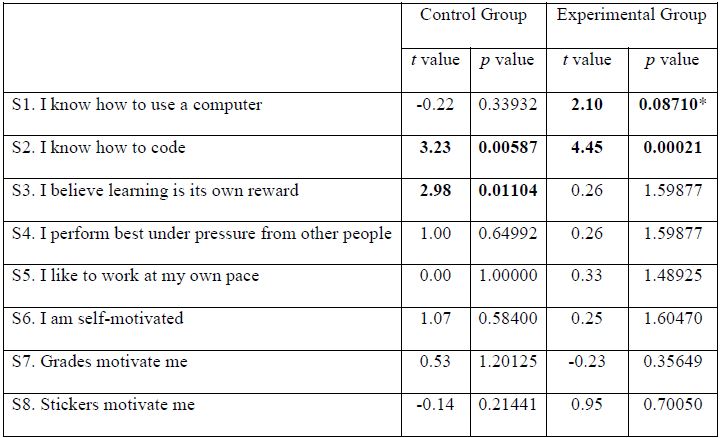
This leads me to believe stickers inflate a false sense of accomplishment for students. It is up to teachers then to determine whether or not that is actually a bad thing. After all, some students need to feel a sense of pride and accomplishment for unlocking different achievements or performance mastery goals.
Teachers should be wary though not to harm the belief that learning is its own reward by providing incentives that reduce natural, intrinsic motivation. As seen above, students in the control group significantly perceived learning to be its own reward after being deprived of stickers. These stickerless students kept coding anyways because they wanted to code… that’s it.
The most statistically significant finding from my study is that the Code.org curriculum really works to change students’ perceptions about their ability to code regardless of whether or not stickers are involved. That is a big deal, and I want to congratulate everyone at Code.org for developing such a fine product and making it free to the world.
If you want your own copy of my totally rad (but also totally ineffective) stickers, here you go. I printed them out on Avery 6450 1-Inch Diameter Round Labels.
The entirety of my research paper can also be read here: The Sticker Study
 Buck School